
How Does Paintless Dent Removal Work?
The science behind metal memory and precision repair. Paintless dent removal works by carefully manipulating damaged vehicle metal back toward its original shape with specialized rods, glue-pulling systems, precision lighting and controlled pressure.
Direct answer: Unlike conventional body repair, PDR preserves the original factory paint and avoids sanding, body filler, primer and repainting when the damage qualifies. The technician completes the repair through hundreds—or sometimes thousands—of extremely small, controlled movements.
Quick navigation
What Is Paintless Dent Repair?
Paintless dent repair is a specialized method of removing dents from automotive body panels without sanding, filling or repainting the damaged area.
Instead of covering the dent with body filler, the technician reshapes the existing metal. This may be done by applying controlled pressure from behind the panel or carefully pulling the damaged area from the exterior with adhesive tabs.
The goal is not merely to make the dent less noticeable. A high-quality PDR repair aims to restore the panel’s original contour, reflection, texture and appearance while keeping the factory finish intact.
Both steel and aluminum panels may qualify, although each material responds differently and may have manufacturer-specific repair limitations. Repairability depends on the panel, impact, coating condition, access and the vehicle maker’s procedures.
Learn more about American Dent Removal’s mobile PDR service for Fresno, Clovis and surrounding Central Valley communities.
PDR is commonly evaluated for:
- Door dings
- Shopping-cart dents
- Hail damage
- Minor collision dents
- Shallow bodyline damage
- Certain creases
- Parking-lot damage
- Steel and aluminum panels
Why manufacturers and dealerships use PDR
PDR can correct qualifying cosmetic damage without replacing the vehicle’s original finish. Dealerships use it for transportation damage, inventory door dings, lease-return damage and used-vehicle imperfections. Collision facilities and insurers also use it for qualifying hail claims.
A brief history of PDR
Modern PDR evolved from metal-finishing methods used in automotive manufacturing and vehicle preparation. Specialized rods, reflection systems, adhesive pulling tools and precision tips gradually developed it into a dedicated repair discipline.
Professional assessment comes first
PDR must be performed within the vehicle manufacturer’s repair guidance. Panel material, structural location, previous repairs, corrosion protection and access requirements can determine whether the method is appropriate. A reputable technician should never assume that every dent can—or should—be repaired with PDR.
Why Metal Can Return Toward Its Original Shape
Vehicle panels may look rigid, but sheet metal has a controlled amount of flexibility. The amount of deformation, stretching and residual stress determines how much of the original contour can be recovered.
What is “metal memory”?
Metal memory is an informal PDR term for the tendency of a formed vehicle panel to retain characteristics of its manufactured shape. Sheet metal is stamped into a specific contour, and its curves, edges, reinforcement points and bodylines contribute to its strength.
When a minor impact pushes part of the panel inward, the surrounding shape and tension can help guide the damaged section back toward its original position.
Metal does not literally remember its shape like stored computer data. The result depends on material properties, panel geometry, impact severity, stretching, work hardening and paint condition.
Elastic deformation
The material changes shape under force but returns when that force is removed. It remains within its elastic range.
The yield point
This is the transition between temporary deformation and permanent change. Once exceeded, the panel does not fully return by itself.
Plastic deformation
This is the permanent shape change left after the metal passes its elastic limit. Most PDR repairs address some degree of plastic deformation.
Why technicians use hundreds of small movements
A dent cannot usually be corrected safely with one large push. Large movements concentrate force and may create high spots, cracked paint, tool marks, waves, reverse dents, distorted bodylines or uneven orange-peel texture. Professional technicians divide the repair into extremely small adjustments, then read the panel again before continuing.
Understanding the Anatomy of a Dent
A dent is not simply a low spot. Impact energy travels outward, moving the metal inward, outward and sideways. The visible depression is only one part of the damage.
The impact point
The object’s shape, speed, angle and material determine how force enters the panel. A rounded object may create a broad depression; a narrow object may create a sharp center or crease.
The low point
The low point is the portion displaced inward. The deepest visible area is not always the first place that should be pushed.
Crowns
Raised or tensioned areas around the dent can lock the low point in place. Technicians often soften crowns before completing the central repair.
Compression and stretching
Some areas are compressed while others are pulled apart. Severe stretching can create more surface area than originally existed.
Stored energy
Residual stress explains why pressure in one area can move another. A dent may temporarily look worse while tension is redistributed.
Surface texture
The panel may be generally level but still show waves or mismatched reflection texture. Final refinement matters as much as the major movement.
Why Dents Do Not Simply “Pop” Back Out
Most dents are held in place by permanent deformation, surrounding crowns, bodyline tension, panel reinforcement and stretched material—not by a single inverted bubble.
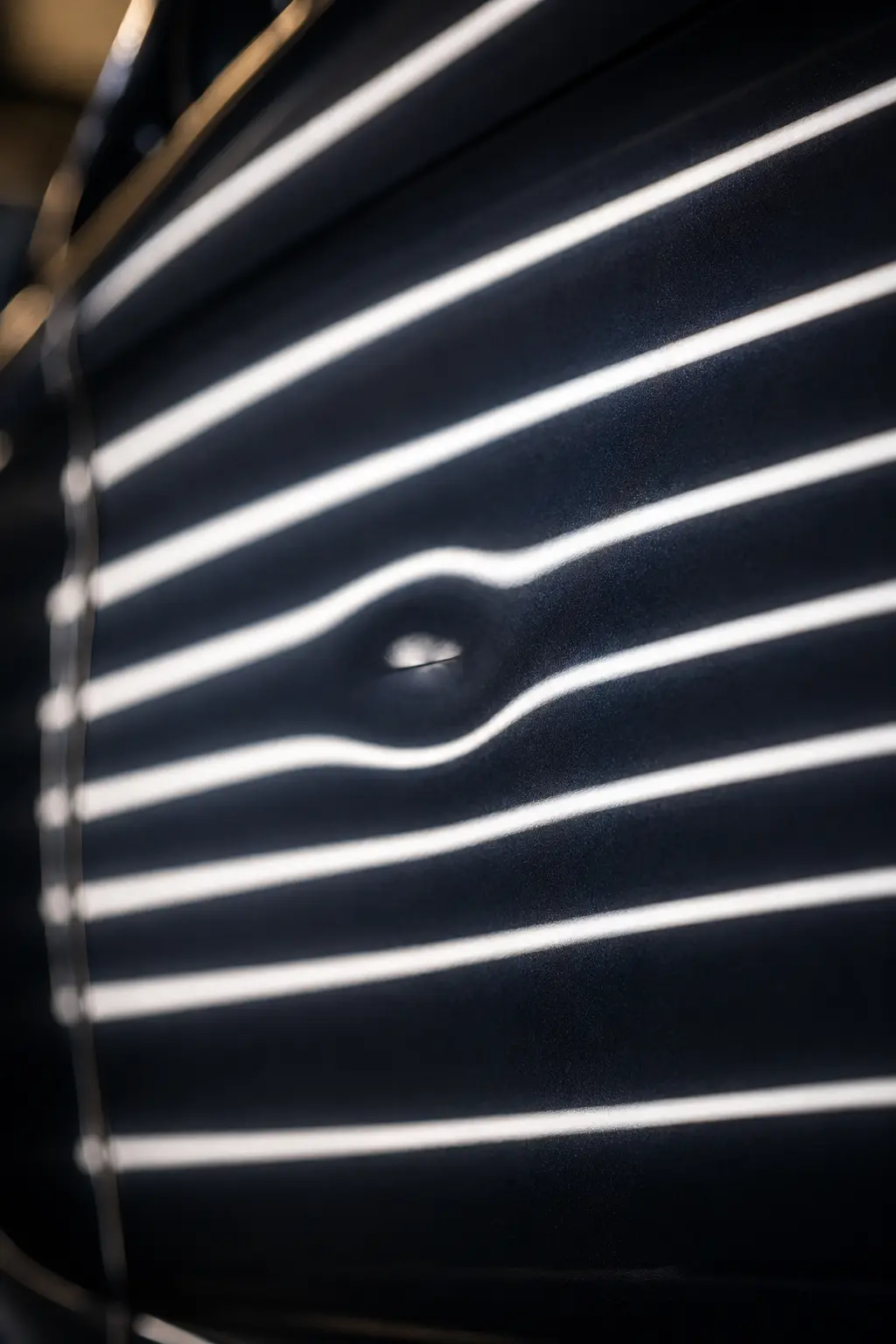
Even when a dent appears to pop outward, the panel may still contain a shallow low spot, raised edges, rippling, a soft center, stretched metal, damaged paint or uneven texture.
Do suction cups work?
A suction cup creates broad pulling force. It may improve a large, soft dent with limited stretching, but it cannot precisely control individual lows, crowns or stress lines. The center may move while the edges remain distorted.
Does boiling water remove dents?
This advice is more commonly associated with flexible plastic bumper covers than painted steel or aluminum panels. Heat may soften some plastics, but uncontrolled hot water near paint, trim, electronics or adhesives introduces risk and does not correct the dent’s stress pattern.
What about hair dryers, dry ice and temperature shock?
Heating and cooling can make materials expand and contract, but the movement is difficult to control. Sudden temperature changes may also stress already damaged paint.
Cheap DIY kits can move metal—but movement is not the same as a finished repair
Common problems include pulling the center too high, creating multiple high spots, removing paint from a repainted panel, using the wrong tab size, ignoring crowns, applying force in the wrong direction and making later professional repair more difficult.
The Specialized Tools Behind Professional PDR
Technicians select tools according to dent location, depth, panel access, material and shape. A tool suitable for a shallow door ding may be wrong for a sharp aluminum bodyline dent.
PDR rods
Different lengths, diameters and tip shapes deliver leverage from behind a panel.
Whale tails
Thin, flattened tools slide behind braces and through spaces where round rods may not fit.
Knockdowns
Plastic, nylon or polished-steel tips lower highs, release crowns and refine texture.
Glue tabs
Exterior pulling tabs distribute or concentrate force according to their size and shape.
Blending hammers
Controlled tapping helps release tension and match the repaired area to factory texture.
Reflection lights
Lines or gradients expose precise lows, highs, crowns, waves and tool-tip position.
Reflection boards and LED lights
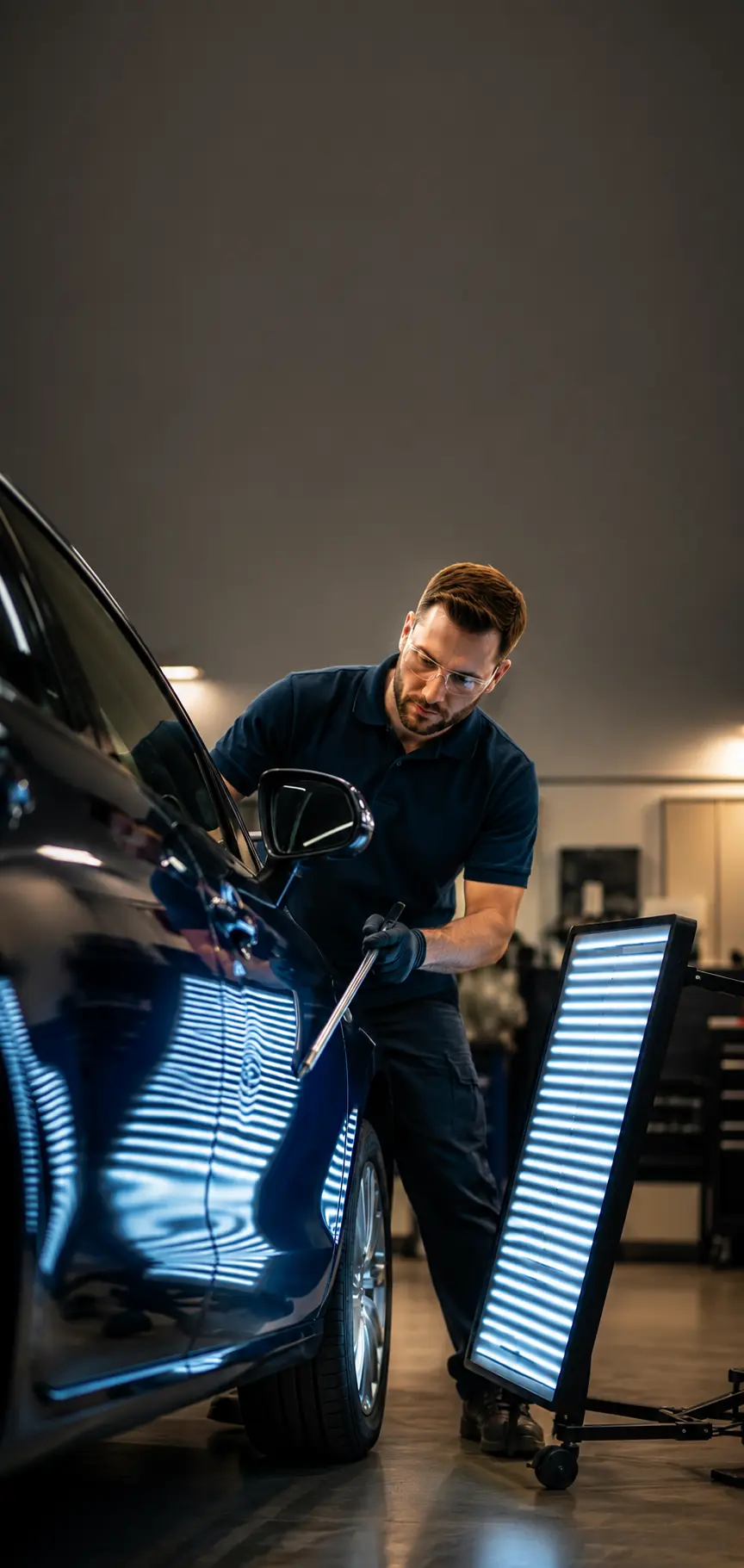
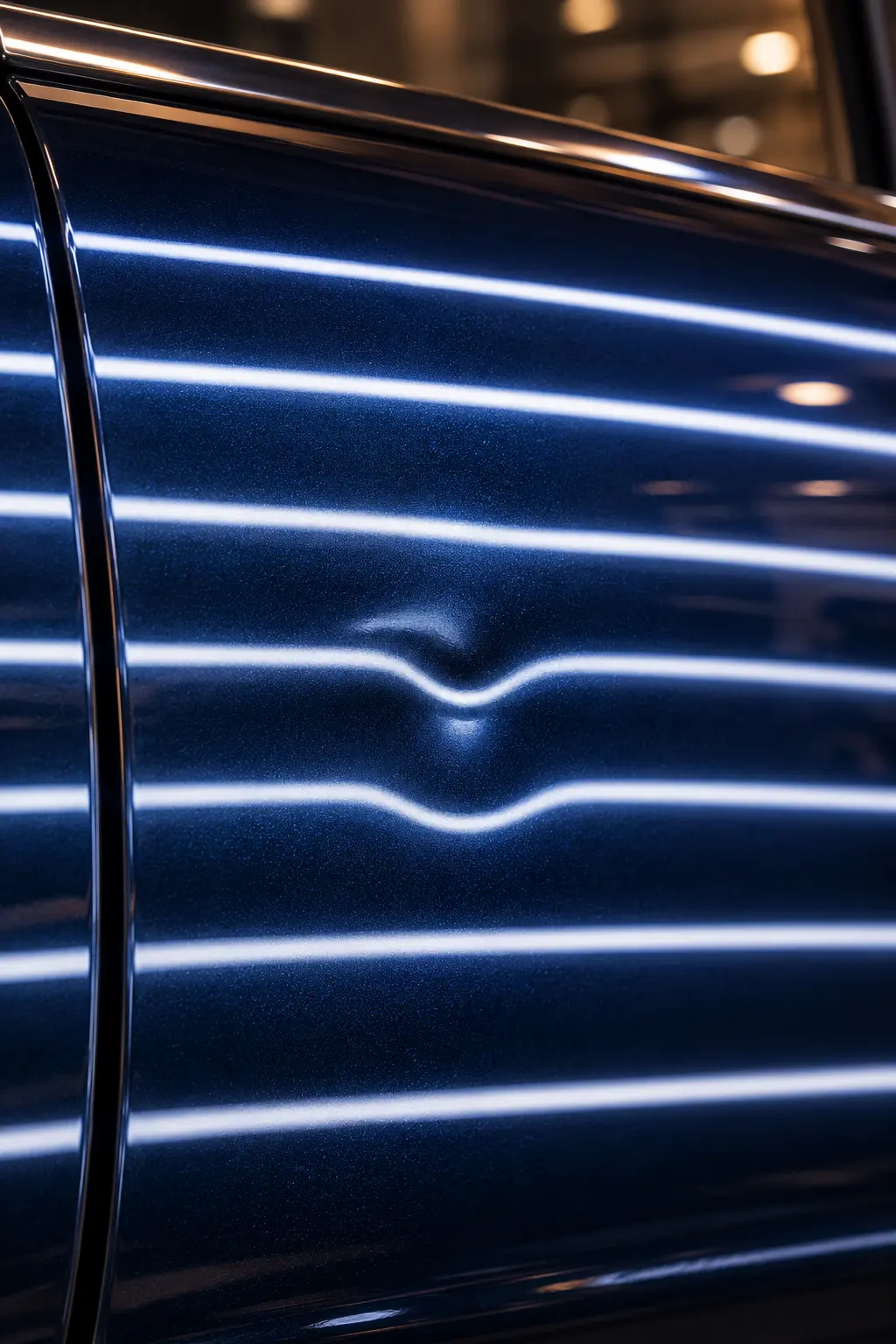
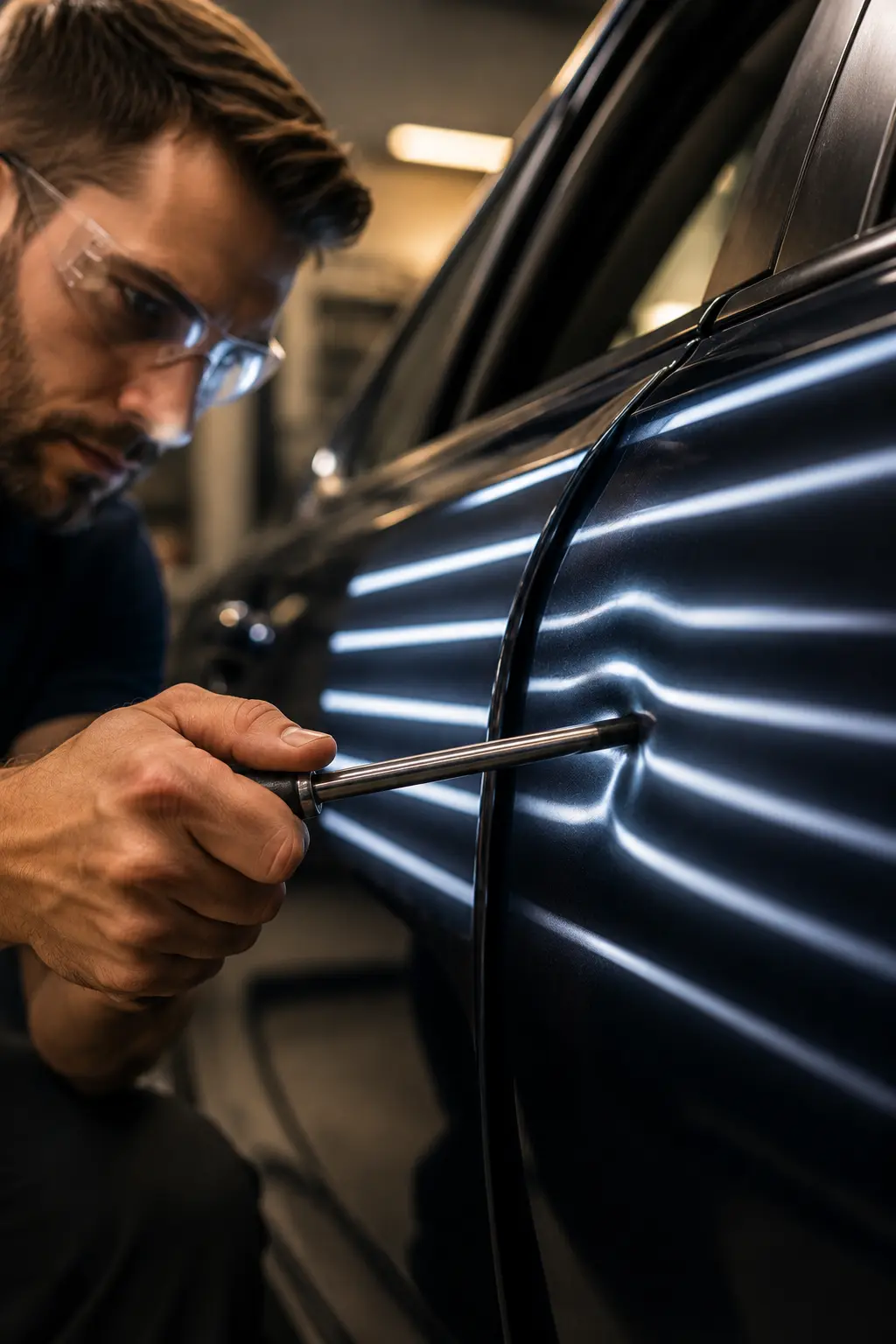
One of the most important PDR tools never touches the vehicle. A reflection board or LED light projects straight lines, gradients or controlled light patterns across the panel.
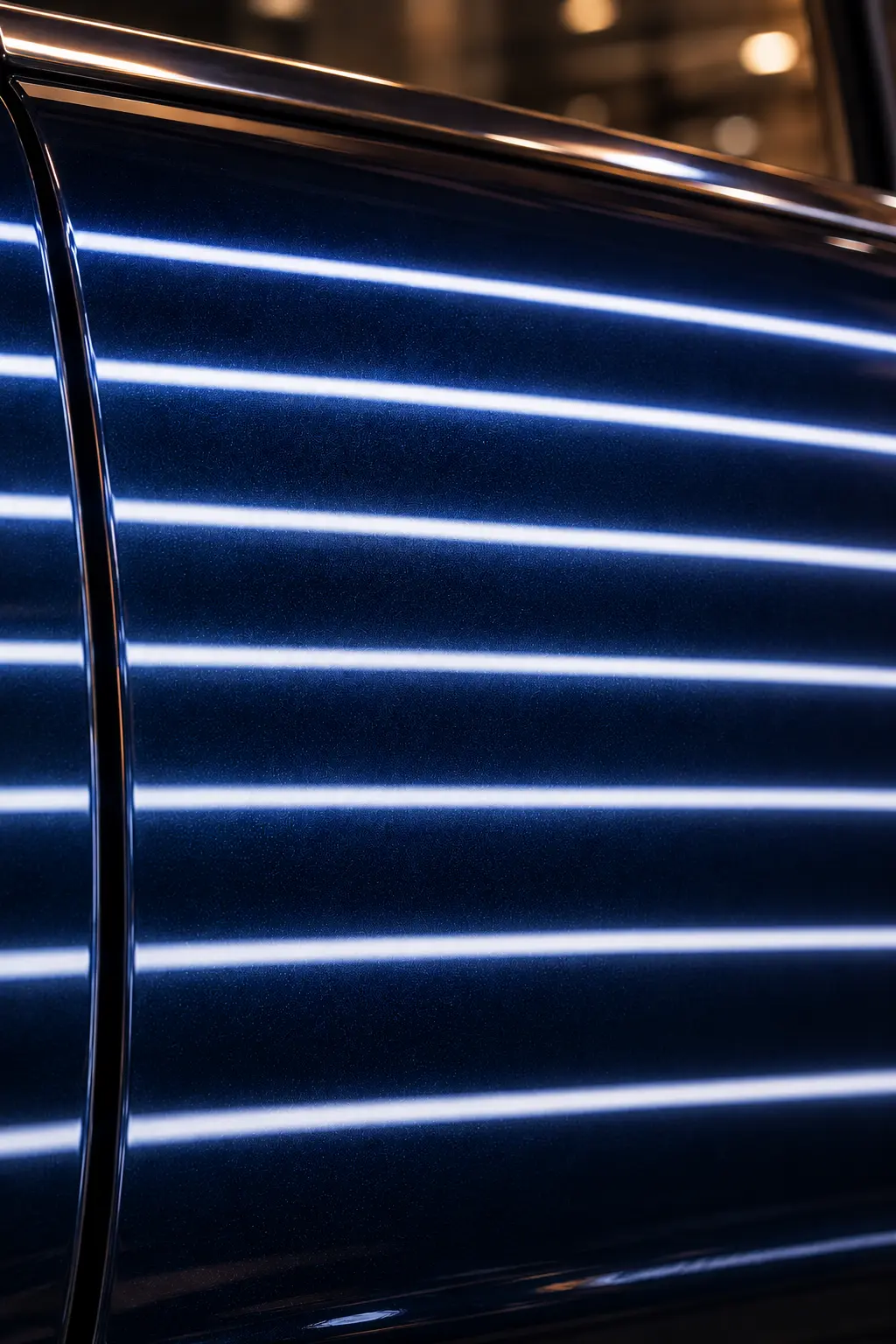
When the panel is flat, the reflection appears smooth and consistent. Over a dent, the lines bend, widen, compress or break. The technician reads those distortions to locate the precise low point, microscopic high spots, crowns, surface waves, texture changes and tool-tip placement.
PDR rods and whale-tail tools
Rods provide leverage from behind the panel through factory access points, open cavities or trim-access areas. Tip shape controls force: a sharp tip concentrates pressure, while a broader tip spreads movement.
Knockdowns
A knockdown is placed on a specific high or crown and tapped with a small hammer or blending tool. It does not “hammer the dent flat”; it releases tension and refines the surface.
Glue-pulling systems
Glue pulling helps when direct backside access is limited. The panel is cleaned, a matching tab is bonded to the target, controlled pulling force is applied, and any resulting highs are carefully reduced.
Blending hammers
Factory paint often contains subtle orange-peel texture. Controlled blending helps the corrected area reflect light like the surrounding finish rather than appearing unnaturally sharp or soft.
Important paint limitation
Glue pulling may not be appropriate on loose, cracked, compromised or nonfactory paint because pulling force can separate weak paint from the panel.
Inside the Technician’s Mind
The technician combines visual information from the reflection, physical feedback through the tool and an understanding of how each movement affects the rest of the panel.
Reflection
The technician watches changing light patterns rather than relying only on the visible dent.
Hand pressure
Too little pressure does not move the metal; too much can create a high spot or damage paint.
Finger sensitivity
Tool contact, braces, movement and leverage can be felt through the handle even when the tip is hidden.
Tool angle
Force direction matters as much as force amount. A poor angle can move the panel incorrectly.
Sound feedback
Subtle sounds may reveal slipping, brace contact or movement against the wrong surface.
Muscle memory
Repeated repairs improve fine control, while every new dent still requires an individual strategy.
Why experience matters
An experienced technician considers how the impact entered the panel, which crowns are locking the dent, whether the paint remains safe, where to begin, which access route causes the least disruption, how the material will respond, when heat is appropriate, when to switch tools and when additional movement creates more risk than benefit.
The Step-by-Step Paintless Dent Repair Process
No two dents follow exactly the same sequence, but a professional repair usually includes these seven stages.
Vehicle and damage inspection
The technician evaluates dent size, depth, impact direction, paint condition, panel material, bodyline involvement, access, braces, previous bodywork, corrosion, sensors, wiring and evidence of stretching. A paint-depth gauge may help identify previous refinishing.
LED mapping
The light reveals lowest points, crowns, stress lines, highs, waves beyond the visible dent and the direction in which the metal moved. This map determines the repair strategy.
Access planning
Possible routes include factory openings, window-belt areas, lamp openings, hood or trunk structures, interior trim, fender liners or exterior glue pulling. Wiring, glass, airbags, intrusion beams, adhesives and corrosion protection must be considered.
Releasing crowns and stress
The technician may tap down crowns, soften a crease, make broad pushes, use controlled heat or pull a wider area before refining the center.
Controlled micro-pushing or pulling
The low area is raised gradually through small movements. After each series, the technician pauses, repositions and reads the reflection again. Deep or complex damage cannot safely be rushed.
Blending and texture refinement
Fine-tip pushes, knockdown work, soft blending, heat management and viewing from several angles correct remaining highs, lows and waves. The final portion may demand more precision than the first major movement.
Final quality inspection
The technician checks contour, reflection consistency, bodyline alignment, paint condition, texture match, trim installation, component operation and cleanliness. Backside protective coatings may also require restoration after tool contact.
Why Aluminum Is Often More Difficult Than Steel
Both steel and aluminum dents may qualify for PDR, but aluminum often demands different tools, pressure, temperature control and repair expectations.
| Repair factor | Steel | Aluminum |
|---|---|---|
| Movement response | Often responds in a more familiar, gradual way. | May feel less forgiving and demand more deliberate movement. |
| Springback | Technician accounts for the panel’s return after pressure. | Different springback behavior can increase the risk of overcorrection. |
| Work hardening | Repeated movement still affects the metal. | Previously deformed areas may become progressively more resistant. |
| Heat behavior | Retains localized heat differently. | Dissipates heat efficiently, making controlled temperature harder to maintain. |
| Tools and practices | Standard steel-panel tools and practices may apply. | Material-specific tools, isolation and procedures may be required. |
| Typical repair time | Depends on damage and access. | May take longer because pressure and heat must be managed more carefully. |
Aluminum does not make PDR impossible
It makes proper assessment, manufacturer-specific limitations and technician experience more important. I-CAR training addresses small-dent removal on both materials, and published OEM guidance can place individual limitations on repairable areas.
Why Factory Paint Is So Valuable
A vehicle’s finish is not one layer of color. It is a coordinated coating system designed for adhesion, corrosion resistance, appearance and durability.
A simplified OEM coating structure can include pretreatment, electrocoat or E-coat, primer or primer surfacer, basecoat and clearcoat. Pretreatment helps the later coating layers adhere and resist corrosion, while electrocoat protects the body beneath the visible finish.
OEM finishes are applied and cured in a controlled manufacturing environment. A collision repair facility can produce excellent refinishing, but it does not recreate the complete factory process on an assembled vehicle.
Factory paint is also thinner than many owners expect. PPG notes that a typical referenced OEM finish is approximately 90–120 microns—around the thickness of a human hair. That thin system must flex while the technician moves the underlying metal.
Orange-peel texture
Factory paint often has subtle texture. A repaired panel must match surrounding reflection rather than looking microscopically flatter or sharper.
UV resistance
The clearcoat is exposed to sunlight, weather, washing and contamination. PDR avoids creating a new blend edge when refinishing is unnecessary.
Corrosion protection
Pretreatment and E-coat protect the panel. When tool contact affects backside coatings, protection should be restored according to appropriate repair procedures.
What conventional refinishing may involve
- Grinding or sanding
- Metal reshaping
- Body filler
- Filler sanding
- Primer
- Color matching
- Basecoat
- Clearcoat
- Blending
- Curing and polishing
Conventional body repair is not inherently poor. It is necessary when the damage is too severe for PDR. The point is that sanding and repainting should not be performed when the existing panel and coating can be safely restored without them.
Paintless Dent Repair vs. Traditional Body Repair
PDR is generally preferred when the paint is intact and the metal remains repairable. Conventional repair is necessary when severe stretching, paint damage, rust, structural damage or panel replacement is involved.
| Repair factor | Paintless dent repair | Traditional body repair |
|---|---|---|
| Original paint | Remains intact when the panel qualifies. | Repainting is usually required. |
| Body filler | No exterior body filler. | Body filler may be used. |
| Finish | Preserves the factory coating. | Creates a refinished surface. |
| Appearance and value | Often supports original appearance and finish continuity. | Repair may be identified through paint inspection or history records. |
| Time | Many minor repairs can be completed relatively quickly. | Refinishing stages may require several days. |
| Materials | Uses fewer refinishing products. | Requires primer, paint, clearcoat and related materials. |
| Color matching | Not required when paint remains intact. | Accurate color matching and blending are required. |
| Best suited for | Qualifying cosmetic dents. | Paint damage, major deformation and replacement work. |
| Core skill | Precision diagnosis and metal movement. | Metalwork, preparation and refinishing. |
For a focused local comparison, read Paintless Dent Removal vs. a Body Shop in Fresno.
Choose PDR when:
- The paint remains intact
- The metal is not stretched beyond repair
- The location can be accessed safely
- The panel is not structurally compromised
- The expected outcome meets the owner’s standards
Choose conventional repair when:
- Paint is cracked, missing or severely damaged
- The metal requires substantial reconstruction
- Rust is present
- Body filler already exists
- An edge, mounting point or structure is damaged
- Panel replacement is required
When Paintless Dent Repair Does Not Work
PDR is highly capable, but it is not unlimited. A trustworthy technician should identify when continuing would create a poor result or unnecessary risk.
Sharp creases
Some creases can be repaired, but an extremely sharp fold may concentrate stretching along a narrow line and prevent complete restoration.
Cracked paint
Moving the metal may spread a crack or expose bare material. A combined repair and refinishing strategy may be needed.
Excessive stretching
Additional surface area can leave the panel loose or “oil-canning” after it is pushed outward.
Previous repairs
Hidden filler, thick paint, sanding, weak adhesion, welds or corrosion can change how the panel responds.
Body filler
Filler does not flex like sheet metal and can fracture under PDR pressure. Paint-depth readings may help detect it.
Rust
Corrosion weakens metal and coating. Applying pressure can crack, puncture or collapse the area.
Panel edges
Folded hems, flanges and mounting areas contain multiple layers and high tension. OEM restrictions may apply.
Structural damage
PDR is cosmetic. Reinforcements, mounting points, pillars, intrusion beams, sensor areas and alignment issues require appropriate collision diagnosis.
Panel replacement
Replacement may be correct when repairing the panel would be unsafe, uneconomical or incapable of an acceptable result.
The most professional recommendation is not always the lowest-priced repair. It is the repair method that fits the vehicle’s actual condition and safety requirements.
Common Myths About Paintless Dent Repair
Myth 1: Suction cups can fix every dent
Suction cups apply broad pulling force but cannot precisely correct crowns, sharp lows and texture. They may move certain soft dents, but they do not replace a controlled professional repair.
Myth 2: PDR damages the paint
Professional PDR is designed to preserve intact paint. Cracked, aged, weakened or previously refinished paint can respond unpredictably, so coating condition must be inspected first.
Myth 3: DIY kits work like professional tools
Similar-looking tools do not replace diagnosis, control and experience. Owning a glue tab does not teach someone how to interpret metal tension.
Myth 4: PDR only works on hail damage
PDR can address many qualifying door dings, parking-lot dents, bodyline dents and certain creases. Hail repair is simply one common application.
Myth 5: Aluminum cannot be repaired
Many aluminum dents can be repaired, but they often require different tools, pressure, heat management and manufacturer-specific limits.
Myth 6: A large dent cannot be repaired
Size alone does not determine repairability. A large, shallow dent may qualify while a tiny but extremely sharp dent may not. Depth, stretching, location and paint condition matter more than diameter alone.
Myth 7: The dent will eventually return
A properly completed PDR repair is intended to be permanent because the metal is physically reshaped. A new impact can create another dent, but the original should not simply reappear under normal conditions.
Myth 8: PDR is always cheap
PDR may cost less than conventional work, but difficult repairs can demand many hours, extensive access work and hundreds of precise movements. The price reflects skill, time and complexity—not only material use.
How to Tell Whether Your Dent Qualifies for PDR
Photographs can support an initial assessment, but they do not always reveal the complete depth, panel access or stress pattern.
Your dent may be a strong candidate when:
- The paint is intact
- There is no rust
- The impact is cosmetic rather than structural
- The panel has not been severely folded
- The area does not contain thick body filler
- The dent is shallow or moderately deep
- Access is available directly or through glue pulling
- The metal has not been stretched excessively
Conventional repair may be needed when:
- Paint is cracked or missing
- Bare metal is exposed
- Rust is visible
- The panel edge is crushed
- There is severe collision damage
- The metal has torn
- The dent overlaps a previous repair
- The panel is structurally compromised
- Fitment or safety systems are affected
How to photograph a dent for an initial assessment
- Park the vehicle in natural daylight.
- Avoid direct glare.
- Take one photograph from several feet away.
- Take angled photographs from both sides.
- Include the complete panel.
- Include a close-up of cracked or chipped paint.
- Mention whether the panel was repaired before.
Fresno Parking-Lot Bodyline Dent on a 2019 Honda Accord
This bodyline dent came from a shopping-cart strike in a Fresno grocery-store parking lot. The dent sat along the lower bodyline of the rear door—damage that many drivers assume will require filler and repainting.
Using an LED reflection line board, the technician mapped the low point and surrounding crown by watching how the light lines bent across the panel. Because the panel was steel and the paint was undamaged, it was a strong PDR candidate.
Repair sequence
- Inspect the coating and confirm that the original paint remained intact.
- Map the low center and crowns with LED reflection lines.
- Plan safe backside access to the rear door panel.
- Soften the crown before concentrating on the deepest low.
- Raise the general low with broader movement.
- Refine the deepest points with a finer tool tip.
- Blend small highs into the surrounding factory texture.
- Verify straight, even reflection lines from the same viewing angle.
No filler, sanding or repainting was required.
A repair decision—not a sales pitch
American Dent Removal evaluates each vehicle individually. When PDR appears appropriate, the repair process and expectations are explained. When the damage requires conventional bodywork, refinishing or replacement, the recommendation should say so. Not every dent should be repaired with the same method.
Paintless Dent Repair Answers
Open any question below for a direct answer. FAQ schema is intentionally omitted from this widget so Rank Math can manage structured data without duplication.
How does paintless dent removal work?
Paintless dent removal gradually reshapes damaged vehicle metal through controlled pushes from behind the panel or adhesive pulling from the exterior. Technicians use specialized lighting to identify low points, crowns and surface distortion while preserving the original paint whenever the damage qualifies.
What is paintless dent repair?
It is a method of removing dents without sanding, applying body filler or repainting the exterior. The existing panel is reshaped instead of being covered with replacement materials.
Does paintless dent repair really work?
Yes. PDR can produce an excellent and permanent result when the paint remains intact, the metal is not stretched excessively and the damage can be safely accessed. Results depend heavily on technician skill and panel condition.
Will the dent come back?
A properly completed repair should not simply return because the metal has been physically reshaped. A new impact or an unrecognized structural problem can create future damage.
Is paintless dent repair permanent?
Yes, a properly performed repair is intended to be permanent. The panel is not temporarily held outward with suction or adhesive.
Can deep dents be repaired?
Some deep dents can be repaired, but depth increases the likelihood of stretching and paint damage. A broad deep dent may qualify while a small sharp impact may not.
Can PDR fix creases?
Many creases can be improved or repaired when the paint remains intact and the metal has not been sharply folded. Long or sharp creases require more time and may have limitations.
Does insurance cover PDR?
Insurance may cover PDR after a covered event such as hail, vandalism or a collision. Coverage depends on the policy, deductible, cause of loss and insurer’s assessment.
How long does paintless dent repair take?
A simple door ding may take less than a few hours. Complex bodyline damage can require several hours, while extensive hail damage may take one or more days. Access, material, depth, location and dent count all matter.
Can aluminum be repaired with PDR?
Yes, many aluminum panels can be repaired. Aluminum generally requires material-specific tools, heat management, additional experience and compliance with OEM limitations.
Does PDR damage vehicle paint?
PDR is designed to preserve intact paint. Risk increases when paint is cracked, brittle, poorly adhered or previously refinished. Inspection and controlled temperature help manage that risk.
Why can PDR be expensive?
The price reflects difficulty and time rather than the quantity of material used. Complex dents may require hundreds of precisely placed movements, trim removal, lighting, heat control and extensive finishing.
Is PDR better than body filler?
PDR is generally preferable when the original metal and paint can be restored safely. Body filler is useful when conventional repair is necessary. The panel’s actual condition determines the correct method.
What size dent can PDR fix?
There is no universal maximum size. Large shallow dents may qualify, while tiny sharp dents may not. Depth, stretching, location, material and paint condition matter more than diameter alone.
Can PDR repair hail damage?
Yes. PDR is widely used for qualifying hail damage because multiple dents can often be repaired without repainting the hood, roof, trunk and side panels. See American Dent Removal’s hail damage repair service.
Does PDR affect resale value?
PDR can help preserve the original finish because a qualifying panel is not sanded or repainted. Resale value still depends on overall condition, repair quality and damage history.
How much does the paint move during PDR?
The paint moves with the underlying metal. The amount varies according to depth, material, temperature, coating condition and repair strategy.
Can an old dent be repaired?
Yes, many old dents can be repaired. Age alone does not disqualify the damage, although rust, paint deterioration, previous repair work and long-term stress can affect the outcome.
Why do PDR technicians use LED lights?
LED reflection lights reveal distortion that ordinary lighting may hide. Reflected lines or gradients locate tiny lows, highs, crowns and texture differences.
Can PDR fix a dent if the paint is chipped?
The metal may still be reshapeable, but PDR does not replace missing paint. Touch-up or refinishing may be required after the dent is corrected.
Can PDR be used near a bodyline?
Yes, many bodyline dents can be repaired. Bodylines contain additional shape and tension, so these repairs often require more precision and time.
Can PDR repair plastic bumpers?
Traditional PDR primarily applies to metal panels. Plastic bumper covers may sometimes be reshaped with controlled heat and pressure, but the materials and techniques are different.

Professional PDR in Fresno and the Central Valley
American Dent Removal provides professional dent assessment and mobile PDR for drivers throughout Fresno, Clovis, Madera, Oakhurst, Tollhouse, Shaver Lake and surrounding Central Valley communities.
Qualifying damage evaluated includes:
- Door dings
- Shopping-cart dents
- Hail damage
- Bodyline dents
- Parking-lot damage
- Minor collision dents
- Steel-panel dents
- Aluminum-panel dents
The approach focuses on preserving the factory finish whenever doing so is safe, realistic and consistent with the panel’s condition.
Industry Sources Used in This Guide
The following official sources support the article’s discussions of material-specific PDR, corrosion protection and OEM coating systems.
- I-CAR: Aluminum and Steel Small Dent Removal
- I-CAR Repairability Technical Support: Rivian Position Statement on PDR
- I-CAR: Aluminum Heat Shrinking and Heat Dissipation
- I-CAR: Corrosion Protection After PDR
- PPG Automotive OEM Coatings: Pretreatment
- PPG Automotive OEM Coatings: Electrocoat
- PPG Refinish: OEM Film Builds